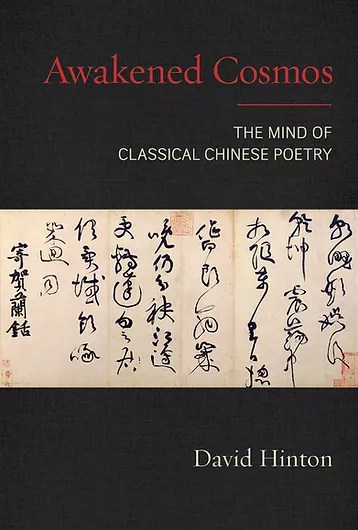
“Awakened Cosmos” is both a collection of translations of the poetry of Tu FU (712 – 770CE) and also contains an attempt at explanation and interpretation. Tu Fu is widely considered to be China’s greatest poet. He was born and lived until middle age under the T’ang Dynasty, however, when he was 43 a civil war broke out, started by the An Lushan rebellion, that was to dominate his experience for the rest of his life. He war killed millions of Chinese and left Tu Fu a refugee, wandering across China looking for safety and financial support
The book is structured in the following way: each chapter begins with the Chinese translation of a poem, then David Hinton’s translation of the poem into English is given, finally this is followed by several pages of exposition and explanation. The themes that are dwelt upon in this book include the difficulty of translating Chinese, especially Chinese poetry, into English. Various reasons for this are given not least that the grammatical structure of Chinese can dispense with the subjective, “I”, whereas English cannot. According to David Hinton to translate a Chinese poem into English is to fundamentally misrepresent it. This is because in Chinese it is possible to represent consciousness without a fixed subjective, whereas this comes much less naturally to English.
According to D. Hinton the structure of Chinese grammar allows words to emerge from the “generative emptiness” of Chinese grammar, just as thoughts emerge from the empty ground of consciousness and “things emerge from the generative emptiness at the heart of the Cosmos”. Naturally the generative source of all three aspects is the same and so Tu’s poetry brings together a unity of language/poem, thought/identity and Cosmos. As those who have practiced meditation will know in meditation thoughts come into being and then disappear again back into the emptiness space of Awareness.
Moreover, whilst Tu’s poetry speaks for the poet himself because of the nature of the poet’s skill he is also, according to David Hinton, speaking for the Cosmos itself – as represented by the poet Tu. Tu is therefore a representation of the universe trying to understand itself.
David Hinton is a writer and translator whose main focus is the interplay of consciousness and landscape. He uses insights taken from ancient Chinese culture to inform his work, much of which draws on his own translations of Chinse poetry and philosophy. According to D. Hinton translation is all about disappearing into the poet’s own work and that humility is the key. His best known work is Mountain Home: The Wilderness Poetry of Ancient China, which translates poets in the mountains and rivers tradition of Ancient China.
Although the language used in “Awakened Cosmos” is a little difficult to follow at times, and I suspect this is partly because D. Hinton has coined his own terms, such as “generative tissue”, it is quiet easy to grasp the general thrust of the argument within one sitting and also therefore come closer to a true understanding of the poet, Tu Fu.
 Mindful Writing